
Learn the art & science of connecting the dots
Most degrees ask you to specialise before you know what the world actually needs from you. At LIS, you don’t choose just one subject: you learn to connect ideas and methods across the arts, sciences and humanities, alongside real work experience, to build the skills employers are actually looking for.
For those who want more from a degree, more knowledge, more skills, more real-world experience. Explore the BASc below.



BASc Degree highlights
Our 'Arts and Sciences: Interdisciplinary Problems and Methods' BASc is the first programme of its kind in the UK. On this course, you’ll study a wide range of subjects under a curriculum that focuses not just on academic areas, but also on real-world problems. This means you will study how the approaches of these subjects can help to solve complex problems.

Undergraduate degree (BASc)
Leo laoreet eget scelerisque consequat viverra et tellus. Leo laoreet eget scelerisque consequat viverr.

September 2027
Leo laoreet eget scelerisque consequat viverra et tellus. Leo laoreet eget scelerisque consequat viverr.

3-years
Leo laoreet eget scelerisque consequat viverra et tellus. Leo laoreet eget scelerisque consequat viverr.

£9,275 / a year
Leo laoreet eget scelerisque consequat viverra et tellus. Leo laoreet eget scelerisque consequat viverr.

London
Leo laoreet eget scelerisque consequat viverra et tellus. Leo laoreet eget scelerisque consequat viverr.

Full-time
Leo laoreet eget scelerisque consequat viverra et tellus. Leo laoreet eget scelerisque consequat viverr.
The Bachelor's of Arts & Sciences (BASc) in Interdisciplinary Problems & Methods
Built for the world you're about to enter
89% of BASc graduates are in employment or further study within 15 months, working across sectors from business and consulting to research, sustainability and tech. In your first two years, LIS brokers an internship built around your interests, a chance to try something new or go deeper into what you already know you want. You leave with a portfolio of real work, not just a transcript.
One lens is never enough
Traditional degrees train you to think in a single subject. The BASc doesn’t. Alongside world-class faculty from Harvard, LSE, UCL and beyond, you’ll draw on subjects like economics, philosophy, psychology and neuroscience, and methods like coding, ethnography, systems thinking, design methods and data science, so you can see a problem from every single it has.
A small cohort, built on purpose
You'll study with a 13:1 student to faculty ratio, in classrooms small enough for real debate. Our support team isn't an afterthought. It's central to how you learn. Our campus is Whitechapel, in the heart of London, so your classroom extends into a network of organisations across the city, working on live problems from day one.
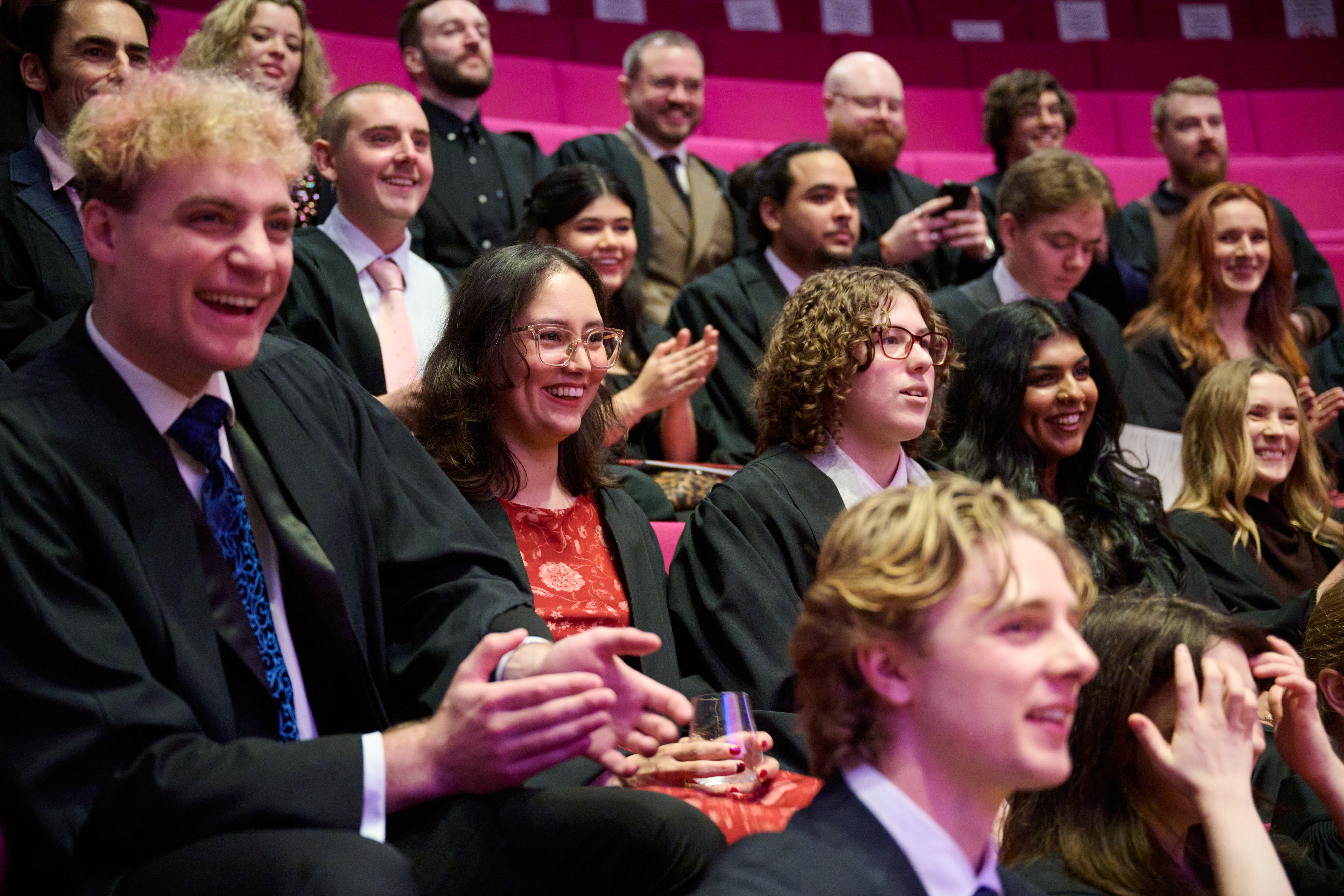
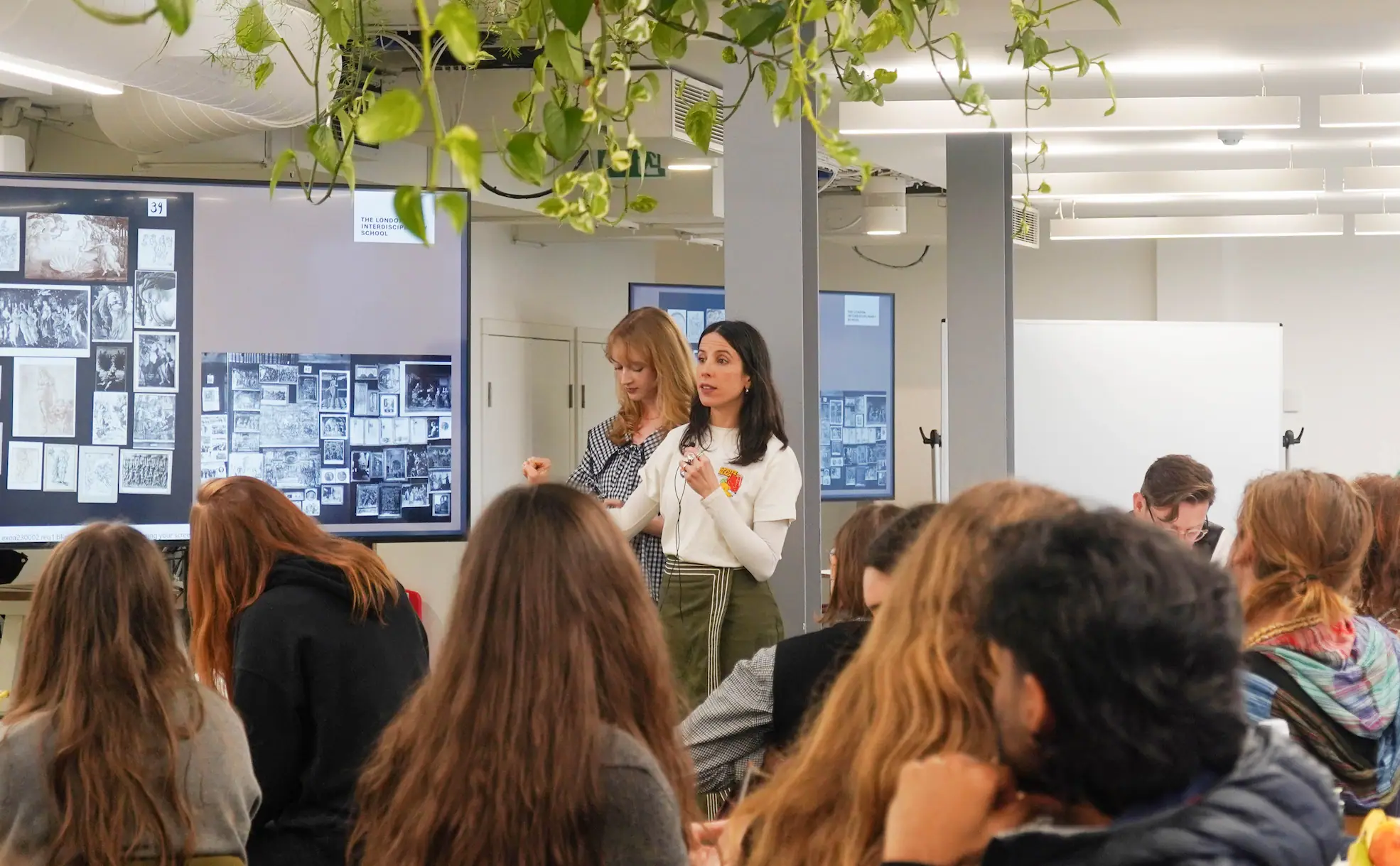
Why LIS and what it gets you
Understand complex problems
Using practical methods, from coding and data science to ethnography, and learning key concepts from disciplines like philosphy, law, neuroscience, and more.
Build a career-ready portfolio
Through real-world projects with external partners, and yearly independant research projects on the problems that interest you.
Gain workplace experience
Through paid summer internships in your first and second year, brokered by LIS.

Hear from our graduates
Real outcomes, in their own words.

.jpg)
.jpeg)

.png)
.jpeg)


Undergraduate careers

Internships. Real work from day one.
In your first and second year, you'll have access to our paid internship programme, placed not on the sidelines, but in the room, applying what you're learning to complex problems in real working environments.
Past placements include KPMG, Innocent Drinks, Fidelity International, Tech Nation, MTR Elizabeth Line, Texture AI, B Corp UK, Spitalfields City Farm, Making Design Circular, and the London Borough of Tower Hamlets.
That means experience across tech, social impact, and the arts, built into your degree, not after it. By the time you graduate, you won't just have a CV line. You'll have a portfolio of work to show.
"The internships have allowed me to understand more about the work I enjoy doing and how I work best. I completed two internships through LIS, in first and second year and learnt more about myself in 11 weeks of interning, than I had in 20 odd years."

One-to-one careers coaching, throughout your degree
The LIS MBA is structured around six fundamental shifts reshaping the world: complexity, energy, intelligence, trust, ecosystems and longevity.
As a Shift Partner, your organisation contributes real challenges for students to research and respond to, bringing fresh thinking shaped by their studies.
Places are limited and shaped closely by faculty — get in touch to find out if there's a fit.
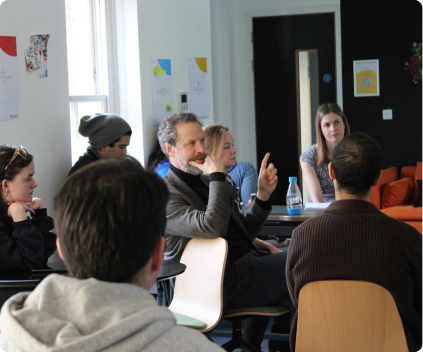
A network of 200+ employers
LIS works with a growing network of over 200 organisations, offering internships, talks, and site visits throughout your degree.
You won't be left to build your career network from scratch after you graduate. You'll be building it from day one.
The curriculum
Throughout Year 1, you’ll gain key knowledge and skills from a diverse range of disciplines, with real-world problems acting as a framework for your thinking. You’ll build on this foundation in Years 2 and 3, becoming equipped with an increasingly sharp, interdisciplinary problem-solving toolkit.
.svg)
We reserve the right to not run a module if there is insufficient student interest.
The content of our modules is subject to change as we revise our modules each year depending on student feedback, developments in the field, and the complex problems of the modern world. To gain a degree in the UK you must pass a certain number of credits in each year of the degree. Each module is given a credit, which you are awarded when you pass each module at assessment.
You'll study the methods that underpin different disciplines, how scientists gather evidence, how social scientists interpret behaviour, how humanists interrogate meaning, and learn to move between them.
That happens through a deliberately varied approach to teaching:



Serious about academics.
Serious about ability too.
This is a demanding degree. You're working with real organisations on real problems from week one, and that takes intellectual rigour and the ability to keep up as those problems shift. That's why we ask for A*AA at A Level (ABB for contextual offers).
But we know grades don't always tell the full story. If yours don't reflect what you're capable of, and you think this is your degree, let's talk. Everyone on track for A*AA goes straight to a single Mindset interview. Everyone else takes an Academic interview alongside it, working through a real problem with our faculty, so you can show us how you think rather than have it inferred from a transcript.
Predicted A*AA?
On track for A*AA at A Level (ABB for contextual offers), and the right subjects in your exams? That's strong academic evidence on its own. You'll go straight to a single Mindset interview with senior LIS staff.
Grades don't tell the full story?
You'll take two interviews instead: an Academic interview, working through a real problem with faculty, and the Mindset interview with senior staff.
Fees and funding
Find out more about our course fees, financing options, and support available through bursaries and grants.
These are the fees for the 2027/28 academic year
Study a year abroad
Between your second and third year, you can choose to study abroad for a full academic year. Spend time immersed in one of our partner universities and return with new perspectives, networks, and experiences that shape your degree in interdisciplinary.
Current destinations include Singapore Management University, Utrecht University and The University of Amsterdam in the Netherlands, and emlyon business school in France.




.jpg)




.svg)
How is the LIS BASc different from a traditional degree?

A traditional degree is built around depth in one subject. The LIS BASc is built around something harder to teach: the ability to integrate. You'll develop genuine grounding across the arts, sciences, and humanities, not a surface-level knowledge, but a rigorous understanding of how different disciplines approach problems and where they can work together. By the time you graduate, you won't just know things, you'll have a new way of thinking that sets you apart.
Why study a BASc?
Because most of the problems worth working on don't fit inside a single discipline. An interdisciplinary degree gives you something a traditional degree doesn't: the ability to move between frameworks, apply different methods to the same problem, and see what others miss because they're only looking from one direction. Employers are increasingly looking for exactly that - graduates who can think across complexity, not just within their lane.
What is a BASc degree?
BASc stands for Bachelor of Arts and Sciences. It's the degree you'll graduate with from LIS, and the name reflects what it actually is: a programme that draws on arts, sciences, and humanities together, rather than asking you to choose one and go deep on that alone. It's distinct from a BA (which focuses on a single humanities subject) and a BSc (which focuses on a single science subject). The BASc is an emerging degree type in the UK, and LIS offers one of the most distinctive versions of it.




.svg)

