
LIS
What is the London Interdisciplinary School?

The London Interdisciplinary School was set up to offer an alternative method of study for students who want to tackle complex problems in their future careers.
Our undergraduate and postgraduate degrees provide an interdisciplinary approach to teaching. This allows our students to develop skillsets from different disciplines that allow them to think about problem-solving in less isolated ways.
How do your programmes compare to a Liberal Arts & Sciences degree?
There are similarities, but there are also some important differences. Liberal Arts & Sciences degrees offer a mix of disciplines, whereas our programmes are built around complex real-world problems rather than traditional subject boundaries.
Instead of studying disciplines separately, students combine perspectives from fields like anthropology, mathematics and network science to explore issues such as inequality and sustainability. This interdisciplinary approach encourages students to think across boundaries, challenge assumptions and develop more innovative solutions.
Who founded LIS?
LIS was founded by Ed Fidoe, and Chris Persson. Prof Carl Gombrich and Dr Michael Englard joined soon after.
Alongside a wider group of educators and industry leaders, they created LIS with the belief that higher education should evolve to better prepare students for the complexities of today's world.
How is the university supported financially?
LIS is backed by a range of long-term investors, including emlyon, a leading French Grande École, alongside British entrepreneurs, among them founders of Innocent Drinks and Funding Circle, and support from the UK government.
Summer 2026: The London Interdisciplinary School has secured investment over three years from emlyon business school, strengthening a partnership that will accelerate LIS's growth and extend its reach as one of the UK's most distinctive higher education institutions.
Where is LIS located?
The London Interdisciplinary School is based in Whitechapel, East London, a short distance from Shoreditch and excellently connected by public transport. Our campus building has a lot of history behind it, while offering all the facilities a modern university needs to ensure students get the best possible experience throughout their studies.
The BASc degree and curriculum
What degree will I get if I graduate from the BASc at LIS?
You graduate with a bachelor's degree, with the full title 'BASc in Interdisciplinary Problems and Methods'.
BASc stands for 'Bachelor of Arts and Sciences'. Most undergraduate degrees in the UK are either a BA (Bachelor of Arts) or a BSc (Bachelor of Science). The degree at LIS is a BASc, as you take courses from both the arts and sciences. A small number of UK universities offer a BASc degree, including UCL, Warwick, and Brunel.
How does the curriculum work?
The BASc curriculum is built around real-world problems and the methods used to tackle them, drawing from the arts, sciences and humanities.
In Year 1 you study broadly across all of these areas, building a wide foundation of knowledge. In Year 2, you develop deeper expertise in particular methods and gain new conceptual frameworks, with more choice over which electives you take.
By Year 3, the focus shifts to integration, through coaching and teaching, you learn to find and leverage the connections between disciplines and their methods, moving from applying different perspectives to genuinely synthesising them. You'll take a mix of electives alongside a year-long Capstone research project on a problem of your own choosing.
The result is a graduate who not only understands a wide range of disciplines, but knows how to bring them together to tackle complex, real-world problems.
Is this similar to a liberal arts degree?
There are similarities. You study broadly across the arts and sciences, and you have a lot of choice in what you explore. But there is a key difference: a traditional liberal arts degree is organised around academic disciplines, whereas the BASc we offer is organised around real-world problems.
This means we don't assemble a pick-and-mix of subjects. Instead, we draw from psychology, mathematics, economics, philosophy, and many other fields, but only when they're directly relevant to the problem at hand. If you're studying inequality, for instance, you might combine economic analysis of income distribution with anthropological perspectives on fairness, because both genuinely help tackle the problem.
Why do you teach methods rather than subjects?
Understanding methods gives you the ability to engage more deeply and critically with a wide range of subjects. We draw from disciplines like economics, philosophy, psychology, and data science, but only where they are directly relevant to the real-world problem at hand, rather than teaching them as standalone subjects. You won't take a dedicated module in economics or philosophy, but you will engage with them substantively when they are the right tool for the problem you are working on.
This matters because the world has changed. The instant availability of information today, and the rise of AI, means the challenge is no longer finding information but knowing how to evaluate it. Being able to analyse data in a COVID study, spot bias in a political survey, or recognise how a piece of media has been framed are the kinds of critical skills that a grounding in methods gives you.
What methods do you actually teach?
We teach a wide range of methods from data science and mathematical modelling at the science end of the spectrum, to visual methods, visual analysis, interviews, and historical contextualisation at the arts and humanities end. We also teach methods from the social sciences, including survey design, ethnography, and running focus groups.
These broadly fall into two categories: quantitative methods, which involve working with data and numbers, and qualitative methods, which involve interpreting language, images, culture, and human experience. In year 1, all students study both. In years 2 and 3, you narrow your focus towards the methods that interest you most, though all students must maintain some balance of both throughout.
What real-world problems do you focus on?
The complex problems at the heart of the course are scoped out within broad areas like Inequality, Sustainability, Tech and Ethics and Urban Futures. Students then choose specific problems to focus on, such as 'Inequality in mental health treatments between ethnic communities' or 'Sustainable supply chains in the financial sector'. These problem areas mix faculty-selected issues with student interests, and are refreshed regularly to stay relevant.
How do you balance breadth and specialisation across the three years?
Throughout the curriculum, you'll engage with global challenges such as climate change, migration, and AI ethics, with options to choose from various disciplinary perspectives. In years 2 and 3, elective modules allow you to specialise in methods like data science, ethnography, or design thinking, while maintaining a broad interdisciplinary approach. The direction and focus is increasingly yours to shape, though you will always maintain some balance across quantitative and qualitative work.
At the end of years 1 and 2 you undertake a 7-week independent project on a problem of your own choosing. By year 3, your studies are anchored by a capstone project on a problem that matters to you.
What if I'd rather do more quantitative or qualitative work?
The electives in years 2 and 3 give you real flexibility to lean in a particular direction. That said, you will need to engage with some elements of both during the course. We can support you in building competence from a basic level, but a willingness to engage with both quantitative and qualitative approaches is important.
On the qualitative side, the programme includes visual techniques like video-making and photogrammetry, as well as humanities-based methods such as writing and close reading. On the quantitative side, you will engage with data science, coding and mathematical modelling. You don't need a background in any of these to begin, but you should be open to applying them to real-world problems.
What level of understanding of maths do you need to be successful on the BASc?
You don't need an A level in maths to join LIS, though we do require a GCSE grade 6 or above. What matters more is an openness to learning some data science, coding and mathematical modelling once you're here.
We can bring you from a low base to a confident standard in these areas, but you'll need to be committed to the learning and appreciate why being literate in them matters in the modern world.
For students who want to go further, there is plenty of intellectual stretch and challenge available in maths, data science and mathematical modelling. How deeply you engage with these areas will depend on the problems you choose to tackle and the electives you take in years 2 and 3.
Can I do a year abroad?
Yes. From 2026 entry, BASc students can apply to study abroad at one of our partner universities, which are currently based in Chile, France, the Netherlands, and Singapore.
The Study Abroad takes place between Year 2 and Year 3 of the BASc. You'll spend the full academic year enrolled at the partner university, before returning to complete the final year of your degree in London. Find out more on our Study Abroad page.
Am I the right student for this degree?
What sort of student are you looking for?
To enjoy LIS you will need to be someone interested in tackling real-world problems and open-minded about using a wide range of methods to tackle these problems. You will also need to love learning! A lot! We believe learning - widely, deeply and continuously - is the key to success.
Do I need high grades to get in?
Grades are one way of showing us you can succeed on this degree. If you're on track for A*AA at A Level (ABB for contextual offers), that's strong evidence on its own, and you'll move to a Mindset Interview: a chat with senior staff to check LIS is the right fit for you. But we know exams don't always capture how someone thinks, so if your grades don't tell the full story, you'll be invited to an Academic Interview instead, where you can demonstrate your capability directly.
Is it a very ‘academic’ programme?
You will certainly need to enjoy being intellectually stretched to succeed on the programme. We believe that tackling difficult real-world problems requires serious thought, learning and action. However, the main thing is your interest and capacity for learning, challenging yourself intellectually and keeping engaged with the programme - not whether you can score highly on school exams.
Do I have to be good at maths?
Not really. You do not need any maths background at A level to join LIS. However, you need to be really up for learning some data science, coding and mathematical modelling when you get here. We can take you from a low base to a decent standard in these areas, but you need to be committed to the learning and appreciate the importance of being literate in these areas in the modern world. Please note that there is a lot of intellectual stretch and challenge in maths, data science and mathematical modelling on the course for students interested in these areas. This depends on how much you choose to use maths and data techniques in tackling your problems and what electives you take in years 2 and 3.
Will I be able to study Economics or Psychology at LIS?
Yes, you may study these subjects, but only if they are relevant to tackling a real problem! We think there is more value in focusing on the actual problem, rather than just learning in one discipline which may not be so helpful or relevant outside a university.
How does your admission process work?
Grades are one way of showing us you can succeed on this degree, but judging anyone by three or four results alone isn't enough on its own. If you're on track for A*AA (ABB for contextual offers), you'll move to a Mindset Interview: a chat with senior staff to check LIS is the right fit for you. If your grades don't tell the full story, you'll have an Academic Interview as well, where you work through a real problem with our faculty. We then consider your interview performance, your achieved and predicted grades, and your context, to make a fair decision.
I'm really into maths and science, is this degree for me?
Yes! We have outstanding teaching in data science and mathematical modelling. These are the part of science and maths we emphasise because they are so important in tackling real world problems and many areas of research and work today.
Teaching, learning and assessment
What's the workload like?
The workload is intellectually demanding, however, success is more about your interest, capacity for learning and willingness to challenge yourself than achieving high exam scores. Average contact time with teachers is 10-12 hours per week.
Central to our approach is 'prep culture', a form of flipped learning where students prepare material before each class, so that class time can be used to practise methods, deepen understanding and engage in debate. Research shows this approach is more effective than traditional lecture-based learning.
Do you have lectures?
We have very few traditional lectures. Most of our classes are highly interactive, with students working on material they have prepared to some extent before the class.
How big are the classes at LIS?
In the electives in years 2 and 3, classes are between 10 and 30 students. In the compulsory classes in year 1, classes can be the size of the whole cohort, currently between 35-55 students.
How many contact hours of teaching are there per week at LIS?
This varies quite a bit depending on which methods you study but the average time in contact with a teacher is 10-12 hours per week.
How much group work is there at LIS?
In the problems modules (roughly one third of the curriculum) you generally study in groups of 4-5. This is the way most working situations outside of university also operate, so we think it is important to learn how to work well in groups. In the methods modules (roughly two thirds of the curriculum) you will study more on your own as each student must learn the methods we teach.
What kind of assessments do you do?
Our assessments are heavily project-based, with marking criteria focused on how well you apply your learning to your projects. All assessments are internally moderated and externally verified.
Assessments can take many forms, from Jupyter notebooks and coding, to videos, podcasts, manifestos, consultancy reports, and group pitches to external organisations.
What is the Capstone project?
The Capstone is the culmination of your degree, a year-long independent research project where you apply everything you've learned to a complex problem you're passionate about. You'll combine disciplinary perspectives and qualitative and quantitative methods to produce original research. Outputs have ranged from podcasts, apps and exhibitions to economic models and traditional essays, and past projects have gone on to inform real-world policy and practice.
Who are your lecturers and teachers?
Our faculty come from some of the world's leading institutions, including Harvard, Oxford, Cambridge and LSE, with expertise spanning everything from Machine Learning to Visual Art. Alongside leading academics, the LIS team includes world-class entrepreneurs and educationalists with deep expertise in the science of learning. Teaching quality is central to how we recruit, so you can expect to be taught by people who are genuinely committed to great teaching. You can find out more about our faculty on our team page.
Student experience
What size is your cohort?
We currently accept around 35-55 students per year at undergrad and 40 at master’s. So there are currently about 110 undergrads and 40 master’s students around campus. i.e. we are currently small, but big enough to feel like a community. Many students like this because there is much more contact with lecturers and other members of the LIS team than you will find at other universities.
Can I visit the campus before September?
Absolutely. You can sign up for one of our in-person events on our events page, or book a campus visit by completing this form.
Do you have student societies?
One advantage of being a smaller, newer university is that students can be very active in setting up and running their own societies. We have an independent student organisation, LISSA (LIS Student Association), made up of members of the student body who oversee, approve, and allocate budget to societies initiated by students.
There is a diverse range of student-run societies, from film and music to debating, sauna and hiking. If a society you want doesn't exist yet, we actively encourage you to set one up.
While you wouldn't be able to play sport as an LIS team, many students register with other universities or regional teams, and engage more broadly with other universities through their libraries, open lectures and societies.
Find out more about student life at LIS here.
What's the LIS campus like?
The campus is a converted building in the heart of East London. There is a common room designed by students, for students, and our teaching rooms are designed to be welcoming and creative spaces, suitable for the interactive teaching we do. There are also kitchens and coffee machines on most floors.
If you'd like to see the campus firsthand, book a tour with our staff or one of our students by filling out this form.
Do students have access to sports facilities?
While LIS doesn't directly provide sports facilities, numerous gyms across London offer discounts to students. Additionally, LIS encourages and supports student-led societies, such as the Boxing Society, which facilitates regular sessions at designated gyms with professional trainers. These societies often join specific sporting facilities, allowing students to access training, such as boxing, yoga, or other sports. Though LIS doesn't cover general gym memberships, the possibility of financial assistance for society-related activities could be explored based on the society's setup and contributions to the student community.
What size are the BASc cohorts?
We currently accept around 35-55 students per year at undergrad and 40 at master's. So there are currently about 110 undergrads and 40 master's students around campus. Because we're a new institution we are small, but big enough to feel like a community. Many students like this because there is much more contact with lecturers and other members of the LIS team than you will find at other universities.
Where do students live and how can I arrange accommodation?
LIS doesn't own accommodation. Instead, we have established agreements with some of London's leading accommodation providers. This means that you can socialise and live alongside students from a diverse range of backgrounds from other universities in London. In your second and third years, you can choose to remain in the halls, or you might like to share a flat with your friends.
Most halls will offer a range of room options at different price points, so take the time to have a detailed look through each of the websites ahead of choosing your accommodation. You can find more information about our accommodation options here.
What support is offered for neurodiverse students?
Our pastoral services are heavily integrated into the curriculum, working closely with teaching staff and coaches. Our student support team encourages students to get in touch as much in advance as possible to develop learning and student support plans so that from the onset of the programme, we can deliver the learning experience best suited to your individual needs.
What can I do with my degree after LIS?
How do internships work at LIS?
First and second-year BASc students in good academic standing can opt into the LIS internship programme. Internships in London are paid at the London Living Wage and can be part-time or full-time. LIS brokers relationships with potential internship employers and the Futures department supports interested students with the application and/or matching process.
LIS also supports students in applying for internships outside the LIS programme, offering CV and application workshops, mock interviews and insight events, as well as sharing a weekly opportunity newsletter with relevant internship roles.
Past internships have included work with Innocent Drinks, MTR Elizabeth Line, KPMG, TSB and the NHS, among others.
Do you offer career support for students?
Yes, but we think about employability more broadly than most universities. Rather than bolting careers support onto the end of a degree, we build it into the experience from day one.
That means all students have access to 1:1 career coaching and group sessions throughout the degree to develop their professional narrative, CV and interview skills. But it also means working on real briefs set by external organisations, building genuine professional relationships through the LIS Network, a community of organisations and professionals who come into classes and host events and networking opportunities, and developing the kind of adaptable, critical thinking that employers in almost every sector are looking for.
We don't just prepare you for your first job. We prepare you for a career that may look very different ten years from now.
Find out more about our approach to employability here.
What jobs can I get after I graduate from LIS?
The LIS BASc offers effective preparation for traditional and emerging career paths. Graduates work in consulting, finance, advertising, AI & tech as well as education, healthcare, sustainability, charities, sport and academic research.
We also prepare you for jobs that don't exist... yet. That's because 85% of jobs that will exist in 2030 haven't been invented yet, so we focus on giving you the mindset and skills to become a lifelong learner, able to adapt to evolving roles and industries.
LIS also opens doors to less traditional routes, such as building a portfolio career, landing a hybrid role, or founding your own venture. The diversity of where our graduates end up, from Goldman Sachs to sustainability roles in local government to postgraduate study at the RCA, reflects the range of directions an interdisciplinary degree can take you.
Where do LIS graduates end up?
89% of our first BASc graduates are in skilled work and/or further study 15 months after graduation, exceeding the Russell Group average of 80%. 84% completed at least one internship during their degree, which we think goes a long way to explaining that result.
Graduates have gone into a wide range of sectors including business and consulting, research and data, sustainability and ESG, tech and software, finance and investment, government and policy, media and marketing, and entrepreneurship. Recent alumni have joined Goldman Sachs, KPMG, Dentsu Creative and the NHS, started as a Senior Executive for an MP, launched careers in software engineering, operations and the creative industries, and around one in five have gone on to postgraduate study at universities including UCL, KCL and the Royal College of Art.
LIS graduates are also notably more likely to work in sustainability and ESG and research and data than Russell Group peers, reflecting the interdisciplinary and problem-led nature of the degree. Read more about this here.
Bachelor's admissions
How do I apply?
You can apply via UCAS or directly through our website. We operate a rolling admissions process, so we accept applications past the January UCAS deadline, though we encourage you to apply as early as possible. The deadline for students requiring a Sponsored Student Visa is 30th June; for all other students the end of August.
How does your admission process work?
Our process looks at more than exam results, but grades are still the clearest first signal we have that you can succeed on the BASc. If you're on track for A*AA at A Level (ABB if you're eligible for a contextual offer), with a 6 or above in one quantitative and one qualitative GCSE or A Level, that's strong academic evidence on its own. We also accept Scottish Highers and Advanced Highers, the Irish Leaving Certificate, the Welsh Baccalaureate, the International Baccalaureate, and several other Level 3 equivalents, so get in touch if you're unsure whether yours counts.
After you apply, everyone is interviewed, just by one of two routes. Meet our predicted grade bar and you go straight to a Mindset Interview with senior staff, a quick check that LIS is the right fit for you. If your grades sit below that, or you feel your grades don't tell the full story, you'll sit an Academic Interview: a real problem worked through live with our faculty. You'll also do a Mindset Interview.
We also weigh your full profile and personal context. We don't ask Home students for a personal statement.
Both routes are designed to prove the same thing: that you can do this course, and do well on it. Apply via UCAS or directly through our website; admissions run on a rolling basis, so we still accept applications after the January UCAS deadline.
What grades do I need to get in?
Grades are one way of showing us you can succeed on this degree. If you're on track for A*AA at A Level (ABB for contextual offers), with a 6 or above in one quantitative and one qualitative GCSE or A Level, that's strong evidence on its own, and you'll move to a Mindset Interview: a chat with senior staff to check LIS is the right fit for you.
But we know grades aren't everything. Some capable students just don't perform to their potential in exams. If you don't meet the grade requirements, you'll be invited to an Academic Interview instead: a conversation with our academic team around a real problem, where you can show us how you think and adapt under challenge. You'll also complete the Mindset Interview with senior staff. Both paths ask you to prove the same thing: that you can do this course, and do well on it.
Do you accept international students?
Yes. We have a Student sponsorship licence which means we're able to welcome international students onto the course, provided that your visa application is approved by the UK Home Office. You can find out more about this in our International Student Guide.
Fees and funding
What are the tuition fees?
UK students pay £9,275 per year. International students pay £20,000 per year. Student loans are available for eligible UK students, covering both tuition fees and living costs through The Student Loans Company.
Is there financial support available?
Yes. There are several options available to help support you financially at LIS. We offer needs-based bursaries to support underrepresented groups and Scholarships for strong candidates.
For full details on funding, fees and scholarships, visit our fees and funding page.
Will I be able to get a student loan?
LIS is an official provider of Higher Education and can be found on the OfS Register of Providers. Being a registered provider means that students who study at LIS will be able to access student finance (including both tuition fees and maintenance loans).
The MASc Programmes
What degrees do you offer at master's level?
We currently offer three MASc (Master of Arts & Sciences) programmes: AI & Collective Intelligence, Education Futures and Complex Systems and Problems. Each one is built around the same core belief, that the most pressing challenges facing society can't be solved from within a single discipline, but each has its own focus, community and career pathways.
What makes an MASc different from an MA or MSc?
Most master's degrees sit on one side of the fence: arts-based (MA) or science-based (MSc). The MASc is both. All three of our programmes combine rigorous quantitative methods, including data science, statistics and coding, with qualitative approaches like linguistics, visual media and narrative. You don't have to choose a side. The point is learning to move fluently between them.
Which programme is right for me?
That depends on where your interests and career lie.
The MASc in AI & Collective Intelligence is for people who want to understand, design and lead systems where humans and machines think and act together, whether in tech, policy, governance, or organisational strategy. It asks: how do groups and AI systems make decisions, and how can we build better ones?
The MASc in Education Futures is for educators, policymakers and people in learning-related roles (e.g. training, coaching or public engagement) who want to think critically about where education is headed and apply that thinking directly to their practice. It is part-time and remote-first, designed so you can keep working while you study.
The MASc in Complex Systems and Problems is for anyone who wants to develop interdisciplinary problem-solving as a genuine skill. You might already have a specific challenge in mind, professionally or personally, or you might simply see the value in learning to think this way. It is the most general of the three and is available both full-time and part-time.
If you are not sure which programme fits best, join us at an event or get in touch at admissions@lis.ac.uk.
How is the curriculum structured?
All three programmes are built around three strands: Problems, Methods and Research. In the Problems strand, you explore a complex real-world issue in depth. In the Methods strand, you build a practical toolkit of quantitative and qualitative skills. In the Research strand, everything comes together by applying the methods to a problem of your choice in an independent Capstone project.
These strands are designed to intersect and reinforce each other throughout the programme. You are not learning abstract theory on one side and unrelated skills on the other, the methods you learn are always in service of the problems you are investigating.
What problem modules will I study?
This is where the three programmes differ most.
On AI & Collective Intelligence, all students take four core problem modules. How Groups Think: Collective Intelligence and Behaviour covers the psychology and science of group decision-making. AI & Machine Learning focuses on how models work, how they are evaluated and how modelling choices shape outcomes. Hybrid Intelligence: Theory, Practice and Fiction examines how AI is reshaping organisations, roles, and professional life. And Hybrid Intelligence Studio is a five-week, hackathon-style module in which the whole cohort collaborates to design and deliver a real-world output addressing a shared problem of their choosing.
On Education Futures, there are two core problem modules. Education in a Complex World examines global education contexts, the impact of AI on learning norms and assessment, and relational approaches to pedagogy across micro, macro and meta levels. Design for Transformative Learning is where you specialise (in intervention design, learner assessment, or programme evaluation) and design and beta-test your own artefact using Research through Design principles.
On Complex Systems and Problems, you choose one of three problem electives: Cognition and Behaviour (human nature, culture, and the cognitive sciences); Technology and Computation (how humans have augmented their productive and cognitive powers, and the ethical, legal, and creative systems around those technologies); or Systems and Processes (the organisations, institutions, and structures that sustain human life and values).
What methods will I learn?
All three programmes include compulsory modules in Integration, which focuses on how to genuinely synthesise knowledge across disciplines, not just collect it, and a complexity module.
Beyond those, you choose one qualitative and one quantitative methods module. On the qualitative side, the choice is between The Right Word (linguistics, natural language processing, and storytelling) and Re:Form (visual media — photography, 3D modelling, illustration — analysed both qualitatively and through coding). On the quantitative side, you choose between Cracking the Code (learning Python through data science problems, the right starting point for most students) and Everything Counts (probability and statistics, Bayesian and Frequentist approaches, for students who already have substantial experience coding in Python).
Students on Complex Systems and Problems also take Trials and Errors as a core methods module, which introduces the principles of scientific knowledge, experimental design and scientific literacy.
Do I need a background in data science or coding?
No. Cracking the Code is designed to take you from the beginning, and each module starts by walking you through the fundamental first principles of the topic before moving into practice. The emphasis throughout is on understanding how to apply these tools to real problems rather than on syntax for its own sake. The goal is to equip you with just enough knowledge to engage meaningfully with experts in the field, what's sometimes called interactional expertise. What matters is a willingness to engage. Students who already have substantial experience coding in Python can take the 'Everything Counts' module instead.
What is the Capstone?
The Capstone is the centrepiece of all three programmes, a substantial independent research project that is entirely yours. It runs across three stages:
- Discovery: you learn the features of complex problems firsthand, through interaction with external partners from across the private, public and policy sectors, witnessing the real challenges they are tackling and finding inspiration in them.
- Framing: you map out the parameters of your chosen problem area, identifying the relevant data types, concepts, methodologies and stakeholders, as well as those that fall outside your scope.
- Delivery: you conduct your research and develop informed outputs with the support of both internal and external supervision.
The output format is deliberately flexible. Depending on your programme and your goals, you might produce a traditional dissertation, a technical prototype, a policy brief, an interactive visualisation, a creative project, or a suite of educational resources. Whatever you produce is designed to serve as a professional calling card — something tangible that can be delivered to the stakeholders of your chosen problem area, acting as evidence of your thinking and skills.
On Education Futures, the Capstone takes the form of an academic dissertation alongside a real-world output of equivalent depth, such as a strategic policy plan, a Learning and Teaching Strategy, or a suite of transformative resources and educational artefacts.
Who are your lecturers and teachers?
Our faculty come from some of the world's leading institutions, including Harvard, Oxford, Cambridge and the Max Planck Institute, with expertise spanning everything from machine learning and experimental psychology to visual art, environmental science and philosophy. But academic reputation is only part of the picture. Many of our faculty also run their own companies, consult for major organisations, or hold positions in government and policy. This means they understand the demands of the evolving job market firsthand, and bring that understanding directly into the curriculum, keeping it current and grounded in real-world practice.
This is quite different from the experience at many universities, where students are taught primarily by researchers for whom teaching is a secondary commitment alongside their own academic work. At LIS, teaching quality is central to how we recruit, and you can expect to be taught by people who are genuinely invested in it.
Mode of Study and Practicalities
Is there a full-time and a part-time option?
It depends on the programme. The MASc in AI & Collective Intelligence is full-time only, completed in one year, based at our east London campus. The MASc in Education Futures is part-time only, completed over two years, and is remote-first. The MASc in Complex Systems and Problems offers both: a one-year full-time campus-based route and a two-year part-time remote-first route.
It is worth noting that studying remotely does not limit your access to campus. Every programme includes termly Immersion Weeks, which bring all cohorts together on campus for a week of academic, creative, research, and social activities around a theme chosen by faculty. These are a key part of the LIS experience for all students, wherever they are based.
What is the workload like?
Full-time students attend campus three days a week, with approximately 2-3 hours of live classes per day. Part-time students have 3.5 hours of live online learning per week, delivered in one afternoon session split into two classes of 1.5 hours each with a short break in between.
Both full-time and part-time students are expected to prepare for each class, which typically takes 1-3 hours per session. Capstone workshops require around an additional hour of commitment per month. Smaller weekly assessments take approximately 2-4 hours, while larger end-of-module assessments typically take between 6-10 hours.
Do I need to come to London?
Full-time students study at our campus just off Brick Lane in east London and campus attendance is a core part of the experience. Part-time students study remotely, but being on a remote programme does not limit your access to campus. In addition to the termly Immersion Weeks that bring all cohorts together on campus, part-time students are welcome to use campus facilities throughout their studies.
Student Experience
What happens beyond the classroom?
All MASc students have access to the same co-curricular offer, regardless of which programme they are on.
Termly Immersion Weeks bring the whole community together, in person and online, for a deep dive into a theme that sits deliberately outside the taught curriculum. They are not assessed, the point is to enable students to take intellectual risks. Immersion Weeks typically begin with a high-profile external speaker who delivers a keynote talk, with the subsequent days having lectures and workshops.
Thinking Out Loud is a weekly student-led seminar where students share intellectual curiosity, ideas or activities in a 20-minute presentation followed by a 40-minute group discussion. The ID Masterclass is an online series of talks dedicated to exploring the themes of interdisciplinarity and integration, featuring experts from diverse academic and professional backgrounds. LIS also hosts an ID in Conversation series, where thought-leaders come to campus to speak about their expertise and experiences.
How will I be assessed?
Assessment across all three programmes goes well beyond essays. You will build a portfolio of artefacts throughout the year that reflects the kinds of outputs professionals actually produce. Assessments can include extended writing, data analysis and visualisation, slide decks and presentations, producing visual media, applying natural language processing to a corpus, and the Capstone project. The result is a body of work you can share with future employers or use as the foundation for further academic study.
What student support is available?
Every student has a dedicated Academic Tutor who meets with them regularly throughout their studies to support academic development and help manage workload. Students can also access a Student Support Advisor on request for personal or pastoral support, and the Advisor can refer to a counsellor where needed.
What is the campus like?
Our campus is just off Brick Lane in east London, in a building with a long history of philanthropy and social action — it was originally the Salvation Army Mission Hall, and has since been transformed into an award-winning flexible working space. LIS has its own wing with dedicated teaching, study, and social spaces, as well as specialist spaces including a media studio and gallery for exhibiting student work. On the doorstep is Shoreditch, and nearby is the City of London business district. London was recently voted the best student city in the world for its culture, quality of life, and employment prospects.
Careers and Outcomes
Do you offer careers support?
Yes. All master's students access the same four-pillar careers offering: the LIS Network, one-to-one career coaching with internal and external professionals, an Interdisciplinary Career Design Framework and co-curriculars. Our graduate careers offering is designed as a springboard to help you develop your professional identity, build your sense of purpose and grow a network that will allow you to advance your career.
An example of this is our 'Systems Surgeries', where organisations from the LIS Network bring real problems to the table and students consult on how to approach them, whether that is a newly awarded grant or a project the organisation is stuck on. These sessions give you direct exposure to the kinds of complex, real-world challenges you will be equipped to tackle, and students are often invited to continue working on these projects with the organisation in a professional capacity afterwards.
What is the LIS Network?
The LIS Network is a group of 200+ organisations who recognise the power of an interdisciplinary approach. They range from purpose-led startups to multinational corporations, including KPMG, John Lewis, Fidelity, Innocent Drinks and the Mayor of London's office, and all are committed to tackling complex problems. They may want LIS to help them on a specific problem, upskill their team in complex problem-solving, or hire from our student body.
What one-to-one support is available?
Every student has access to a dedicated Careers Manager who can help you develop your career narrative, showcase your existing and new skills in a more powerful way, and make personal introductions on your behalf to members of the LIS Network.
Beyond this, students have access to a range of specialist external career coaches, each dedicated to a specific area: one for building out your LinkedIn profile, one for writing your CV, and one for practising interviews, among others.
One of the more distinctive aspects of the LIS careers offering is that the Futures team actively tracks the problem areas students are working on and seeks out industry players from relevant sectors to connect you with, helping you to ideate on, develop, and potentially offer your project to or with them. You can even request specific people or organisations you would like to connect with. If LIS cannot access them directly, the team will seek out someone from the same field or a closely related one.
What is the Interdisciplinary Career Design Framework?
LIS provides all master's students with a shared framework for career planning, built on Waqas Ahmed's book The Polymath. Through group sessions, students define their goals and exercise agency to achieve them. It is designed specifically for people who are seeking, or already building, interdisciplinary or portfolio careers.
What kinds of roles do LIS master's graduates go into?
The MASc programmes equip you with what is sometimes called interactional expertise: enough knowledge across a range of disciplines to engage meaningfully with specialists in each of them, even if you are not a specialist yourself. This makes your career options highly versatile, because you can work cross-functionally in almost any environment where processes, products, policy, or people need to be managed and improved.
Our graduates go on to roles in startups and entrepreneurial ventures, government and policy, established organisations across the private and public sectors, and everything in between. What they have in common is not where they end up, but how they work: across disciplines, across functions and with the confidence to bring people and ideas together.
Admissions
What are the entry requirements?
The minimum requirement for all three programmes is a 2:1 or above in an undergraduate degree from the UK, or the international equivalent, in any subject. We do not require a specific disciplinary background. What matters is your capacity to engage seriously with complex, interdisciplinary problems.
If you do not meet the standard entry requirement but have extensive professional experience in a related area, your application will be considered on an individual basis. In that case, make sure to include your most recent CV.
For applicants who do not have English as a first language, you may also be required to provide evidence of your knowledge of English. Contact admissions@lis.ac.uk if you have questions regarding English language ability.
What do I need to submit with my application?
All applicants submit a Critical Reflection of 500 to 750 words alongside their application, plus details of prior academics, professional experience (if relevant). You choose a problem that interests you and describe how an interdisciplinary approach could be used to address or explore it. We are looking for your ability to identify and explain multiple lenses on an issue, explore how those perspectives can be integrated, select appropriate sources and communicate clearly in writing.
When should I apply?
Applications are considered on a rolling basis, and we encourage you to apply as soon as possible to secure your place. The final deadlines are 29th August for Home students and 30 June for international students. You can find the application form here.
Can I apply as an international student?
Yes. LIS holds a sponsorship licence and can accept international students. Students requiring an LIS Sponsored Student Visa will need to pass a Secure English Language Test (SELT) taken within the two years prior to application. Further details about the Visa application process will be shared with you at the point of offer, or reach out to admissions at admissions@lis.ac.uk with any questions about your situation.
Fees and Funding
How much does it cost?
Fees vary by programme and mode of study:
The MASc in AI & Collective Intelligence (full-time, campus-first) costs £14,000 for Home students and £25,000 for international students.
The MASc in Education Futures (part-time, remote-first) costs £7,000 per year for two years for both Home and international students.
The MASc in Complex Systems and Problems costs £14,000 for Home students and £25,000 for international students studying full-time, and £7,000 per year for two years for both Home and international students studying part-time.
Fees cover all elements of your registration, enrolment, tuition, supervision and assessment. They do not cover living costs, books, materials, a laptop, or travel. You will need your own device with Microsoft Office (Student Version).
Is financial support available?
LIS offers a number of scholarships to support students in accessing our master's programmes. You can find full details and apply here.
LIS also offers bursaries in the form of partial fee discounts, considered on a case-by-case basis and subject to evidence of need. To enquire, email admissions@lis.ac.uk.
Beyond what LIS offers directly, UK students can apply for a Postgraduate Master's Loan of up to £11,570 to help with fees and living costs. You do not start repaying until you are earning above the threshold, and the rules differ slightly depending on whether you are in England, Scotland, Wales, or Northern Ireland. See gov.uk/masters-loan for details.
International students may also be eligible to study as a Chevening Scholar. See chevening.org/apply for more information.
About the LIS MBA
What is the LIS MBA?
The LIS MBA is a bold departure from the traditional MBA. Rather than teaching business functions in isolation, the curriculum is built around six major shifts reshaping business and society (Complexity, Intelligence, Energy, Ecosystems, Trust and Longevity). It is a cohort-based programme, bringing together a highly engaged group of experienced professionals who learn with and from one another. It is also built to fit around your career, running over 18 months as a part-time, hybrid programme that combines weekly online sessions with in-person immersive residential weeks, so you can keep working while you study.
What makes the LIS MBA different from a traditional MBA?
In a typical MBA, the traditional business functions form the core and more contemporary themes are left to optional electives. The LIS MBA flips this around. The core focuses on the shifting external environment, the six shifts, and uses these to re-examine the knowledge and practice of business functions like finance, accounting, marketing and strategy. It also places greater emphasis on the "inner shift" (personal development to develop the skills needed to lead in complexity and uncertainty) and on systems methods such as systems thinking, mapping and modelling. It is designed for people who can see that their real assets and risks are not well captured by spreadsheets alone.
Do you still cover the traditional MBA subjects?
Yes, though not in the way a traditional programme does. We introduce the core business fundamentals such as strategy, marketing, accounting and finance through self-paced material, giving you a solid grounding in the essentials. We then develop and apply the most relevant and current approaches within the six shifts reshaping organisations today, woven in through the choice of guest speakers and topics, optional sessions, immersive weeks, and the framing of each shift's learning outcomes. The aim is to honour these domains fully without reproducing a whole traditional syllabus alongside our own.
What are the six shifts?
The programme is centred on six global shifts that are transforming organisational management and the world of work. Each forms a 10-week module:
- Complexity: leading amid interconnected systems where cause and effect are hard to trace.
- Intelligence: the rise of artificial and collective intelligence, and human-machine collaboration.
- Energy: the transition from fossil fuels to renewables, and what it demands of every sector.
- Ecosystems: becoming more integrated with the natural world and moving from depletion to regeneration.
- Trust: declining trust in institutions, and how organisations build and maintain it.
- Longevity: the shift from short- to long-term time horizons, in business and in life.
What is the Inner Shift?
Alongside the six outer shifts, an "Inner Shift" sequence runs throughout the programme. Delivered through small-group "Integration" sessions and whole-cohort work (both online and during immersive weeks), it creates space for reflection, sensemaking and personal development. It covers areas such as adaptability, resilience, building trust, team-building and conflict resolution, different forms of intelligence, and sustaining your energy and focus. The aim is to help you work out what these wider shifts mean for you, your career and the work you want to do.
What careers does this MBA prepare students for?
The LIS MBA is designed for mid-careers who already have some professional direction, but who see that their role, their organisation, or their sector is undergoing change. This MBA prepares these professionals to have more agency in shaping that change, which may include defining new roles or new business models.
For those working in large organisations, the LIS MBA augments any one functional skillset (such as in Strategy or Organisational Learning; Operations; Human Resources, People, or Talent; Accounting or Finance; Communications or Marketing; Analytics, Research and Design; Change management and Transformation; Partnerships and Network), allowing someone to work more cross-functionally with a specific skillset around managing multi-disciplinary teams and decision-making via interdisciplinary integration and synthesis.
In terms of more specialist skillsets, the LIS MBA includes exposure to a range of contemporary analytical, communication and facilitation methods, with particular emphasis on systems methods including systems thinking, mapping, modelling and simulation. An LIS MBA graduate will have relative expertise in these methods to work at a 'systems' level.
Is the MBA accredited? Who accredits it?
LIS has unlimited degree awarding powers granted by the UK Government. The LIS MBA is therefore a fully recognised and accredited masters level (Level 7) qualification in the UK's National Qualifications Framework.
How is the LIS MBA recognised within the business community?
The LIS MBA is a response to calls for change that come from within the business community as well as in wider society. You can read a summary of that demand (from one set of perspectives) in a 2024 report commissioned by the B Team, a global collective of CEOs and leaders of multilateral organisations. [LINK NEEDED: "2024 report" → B Team report] The reception to the LIS MBA both in the LIS partner organisations and beyond has been very positive, and following our launch we will be working more publicly to spread awareness of the longstanding recognition within business schools of the need to adapt curriculum more dramatically in response to the changing business environment.
How do I know if this MBA is recognised within the business community?
LIS now has a track record of ensuring that our new degrees, backed by our degree-awarding powers, are recognised and accepted by major employers. Our Head of Futures, in partnership with our Network, works hard to continually understand the needs of the business community as part of a wider environment, and Career Coaches prepare students to be able to identify and articulate how they meet those needs. No MBA guarantees entry to the field of business and many MBAs that are awarded carry a risk that their meaning and value relies primarily on institutional prestige. In contrast, LIS graduates have contemporary skillsets and visible bodies of work that can speak for themselves.
Programme Structure & Delivery
Is this a full-time, part-time, or hybrid programme?
The LIS MBA is a hybrid programme, designed to be flexible for working professionals. Weekly sessions are delivered online, allowing you to continue your career while studying. In addition, you'll attend one in-person immersion week per term (seven in total), where you'll engage with industry experts and tackle real-world challenges related to our six major shifts: Energy, Ecosystems, Trust, Intelligence, Complexity, and Longevity. These immersive and online experiences ensure that learning goes beyond theory, giving you hands-on insights from leaders shaping the future of business.
How long does it take to complete the MBA?
The MBA will take 18 months to complete. Scheduled learning starts in January 2027 and finishes in June 2028.
How is the programme structured?
The 18-month programme is divided into six 10-week blocks, each focused on one shift. Each block combines nine weeks of virtual (online) learning with a week-long in-person immersive residential, giving you both flexibility and deep, hands-on learning. Within each shift you are exposed to a wide range of perspectives on the topic and supported to make sense of them, connect the dots and integrate them into your own thinking. This is what interdisciplinarity means in practice at LIS.
What happens during an immersive (residential) week, and where are they held?
Immersive weeks run over around four to five days, in person at LIS or at other locations relevant to the shift being studied. Each immersive both closes out the shift you have been studying and kicks off the next. Across the week you'll experience the shift first-hand, take part in problem framing with external partner organisations, present your work for group critique ("crits"), attend panels and lectures, and join social events with your cohort.
What is the weekly time requirement?
Weekly virtual learning requires 10 hours' commitment, designed to be completed while working full-time. This involves 2-3 hours of synchronous learning (typically a lunchtime seminar and an additional small-group session), 7-8 hours of asynchronous learning to be completed at your own schedule via access to bespoke material and our carefully curated apps, reels and reading lists.
Can I work while studying for the MBA?
Yes. As a part-time, hybrid delivery programme, it is expected that students will be working alongside study. This will give students the opportunity to apply their learning in real time and bring their findings and experiences to the classroom, adding to the vibrancy of discussion. That said, it is a significant time commitment: plan for around 10 hours most weeks, plus the in-person immersive weeks, so it works best with some flexibility in your schedule and support from your employer.
What learning materials and resources will I have access to?
Virtual learning is supported by a curated set of resources: core readings on the fundamentals of each shift, a Reading List offering extended perspectives on each shift plus select, high-value works on business and management, and a curated feed of podcast and video episodes illustrating frontier principles and practice.
What is the balance between theoretical learning and practical application?
A key aim of the design of the LIS MBA is to increase the opportunity to work on live problems as they arise. In this way, the learning is driven primarily by concerns for practical relevance and application. The background learning material we ask students to engage with balances theoretical works on fundamental and enduring aspects of reality and practical detail of shift- and business-relevant developments in science, innovation, law, culture and experience. Practical value is also co-created within the cohort: integration groups give members a regular space to share their own experience, test ideas against real situations and turn learning into something they can apply directly in their work.
Are there opportunities for industry projects during the programme?
Industry partners help frame the shifts through ongoing conversations, and cohort members can pursue a question that emerges from these, or one of their own organisational or personal questions, over the course of a block. This work is shared for group critique with peers and partners, and there are further opportunities to connect with organisations across the LIS network throughout the programme.
Does this programme offer internships?
The programme is designed for professionals who are already in work or have other responsibilities, and so we are not prioritising sourcing paid internships. Students seeking experience in new roles or sectors can access partner consultancy projects to be completed on a voluntary basis as part of the course.
Teaching, Assessment & Support
Who teaches the programme?
The MBA is taught by a mix of LIS's faculty, bespoke hires, LIS Fellows and guest faculty, bringing together academics, practitioners and industry leaders. The programme is led by MBA Programme Director Dr Amelia Peterson. Small-group coaching sessions are organised by our careers expert, Anna Matei.
How will I be assessed?
Assessment is designed to reflect the kind of thinking and action modern leadership demands, rather than standardised exams. For the six shifts, you'll work with curated material before taking part in live sessions that test your ability to effectively probe and show understanding across domains. The management fundamentals are assessed through workshops and periodic progress testing, and the Inner Shift is assessed through more personal methods, such as reflective activities.
Are students required to complete a thesis or capstone project?
At LIS, there are no term papers or dissertations. Instead, progress testing and oral assessment evaluate how MBA candidates are building specialist knowledge and practicing leadership, supported by coaching and debriefing. To integrate and apply the concepts learnt during the shift, candidates bring their work to a group critique, or "crit," at the end of each block, presenting it to peers and industry partners for discussion and feedback.
Is career coaching offered as part of the LIS MBA?
All LIS MBA candidates will receive dedicated, on-demand career coaching. At LIS, we have experienced career coaches who offer bespoke support with all stages of career exploration, and can be accessed through the course. Career support for the LIS MBA is designed to help all participants build their networks and profiles in a way that complements their learning. Career coaching is only one part of this puzzle: it is a space for reflection and accountability, as well as action. It will help you embed new skills, frameworks or insights into your leadership practice, to turn new career objectives into an action plan, and to drill down on development areas with expert support. 1:1 delivery means every student will be able to set their own goals and will receive bespoke guidance, while also benefiting from whole-cohort learning and support.
Entry Requirements & Eligibility
What are the entry requirements?
The minimum requirements are an undergraduate degree (or UK equivalent), or equivalent professional experience, together with at least six years' work experience, including a minimum of three years' management experience. Where you do not hold an undergraduate degree, significant additional professional and managerial experience can be considered in its place. If you are unsure whether you meet the criteria, you can request a profile review for personalised feedback on your experience and suitability for the course by contacting admissions@lis.ac.uk
Can recent university graduates apply?
To be eligible for the LIS MBA, you would need to have at least 6 years professional experience with a minimum of 3 years management experience. Only mature recent graduates may therefore be able to meet this criteria.
Does my work experience need to include managerial roles?
To be eligible for the LIS MBA, you would need to have at least 6 years professional experience with a minimum of 3 years management experience. We take a broad definition of management experience. We are looking for impactful decision making experience. This may be through management of people, processes, products, services, or other areas of responsibility. Request a profile review to get personalised feedback on your experience and suitability for the course.
Can I apply without a business background?
Your work and management experience does not need to be in the field of business, however defined. The LIS MBA provides education for leaders across sectors, who want to engage in understanding their organisational environment and how their organisation or role may be changing within it. Our professional short courses include a substantial minority of participants from the public sector, third sector, media and research, and this diversity of contexts and viewpoints makes for a cohort that is better positioned to think and act systemically. We aim to build a founding LIS MBA cohort with similar range.
Can I apply without a degree?
Whilst the LIS MBA is an academically challenging and rigorous programme, we as an institution are committed to widening participation where possible and reducing barriers to accessing higher education. We can consider professional qualifications and/or significant professional and managerial experience in place of an undergraduate degree. Request a profile review to get personalised feedback on your experience and suitability for the course.
Do I need a specific undergraduate degree to apply?
LIS doesn't require a specific undergraduate degree. Our cohorts are diverse, representing a wide range of fields. If your degree classification is below a 2.1, we'll look for other evidence of your learning. A traditional degree isn't always a proxy for success in the LIS MBA. If your degree was either quantitative or qualitative and your work doesn't involve calculations or dense texts, consider preparing for these areas. We provide guidance for interview prep and look for evidence of your ability to tackle challenges with determination.
Do I need to take an English language proficiency test?
To be able to fully participate in the programme, including classroom discussions, assessments, and engagement with partner organisations, a high level of English fluency is required. If you are not a national of an English majority speaking country, LIS reserves the right to request an English Language proficiency test as a condition of offer to join the LIS MBA programme.
What GMAT or GRE scores do you accept, and are they required?
We do not require the GMAT or GRE as we believe these assessments have not been able to adapt quickly enough to the changing skillsets that are relevant for organisational leaders. Due to this, and because of the different barriers to entry or to high performance in these tests, we do not give them a separate weighting in admissions decisions. We are using a standardised test as part of the admissions process that is more aligned with the demands of the curriculum and the work of leaders and managers.
Can international students apply for a student visa?
LIS does not offer student visa sponsorship for part-time programmes, including the LIS MBA. Non-UK nationals are welcome to join the programme but will need to ensure they are eligible to study in the UK part-time via alternative routes.
How to Apply
How do I apply? What does the process involve?
There are three main stages. First, an Application: a streamlined form covering your personal details, education, CV and a short critical reflection. Second, an Interview: an in-depth conversation with our faculty and leadership team about your ambitions and fit for the course. Third, an Assessment: a research-based standardised assessment of decision-making, designed to gauge your ability to work with complex material.
What is the application deadline?
We operate Admissions on a rolling basis throughout the year. Note that places on the programme are limited and we therefore encourage early applications.
What are the application rounds and key dates?
Applications for the next cohort are now open. You are welcome to submit at any time, but applications are reviewed in staged rounds, with the following 2026 deadlines: Round 1: 11th March, Round 2: 27th May, Round 3: 15th July, Round 4: 9th September, and Round 5: 11th November. You will be informed whether you have been invited to interview within two weeks of the relevant round's deadline. For any further enquiries, email admissions@lis.ac.uk
When and how should I submit degree transcripts and certificates?
Transcripts and certificates can be uploaded in the "Evidence" section of your application form.
When will I hear back about my application decision?
Our rigorous admissions process has multiple decision stages to ensure a strong fit between the school, the programme, and the candidate. Following submission of a completed application, applicants will hear if they have been invited to interview within 2 weeks. Following the interview and completion of the Admissions Assessment, applicants will hear if they have been admitted to the programme within 3 weeks.
Fees & Funding
How much does the MBA cost?
Tuition is £30,000 for the full degree. It covers all teaching and learning materials, seminars and guest-speaker access, individual coaching and support, and assessment and feedback, as well as membership of The Conduit. Tuition is payable by instalments as standard.
Are fees different for international students?
No. The fee is the same regardless of nationality or domicile.
How can I fund the programme? Do you offer scholarships?
There are several ways to fund the MBA, and many students use a blend of approaches, including scholarships, government or private loans, employer sponsorship and personal savings. We offer a range of scholarships to support outstanding candidates, all applied as tuition fee reductions.
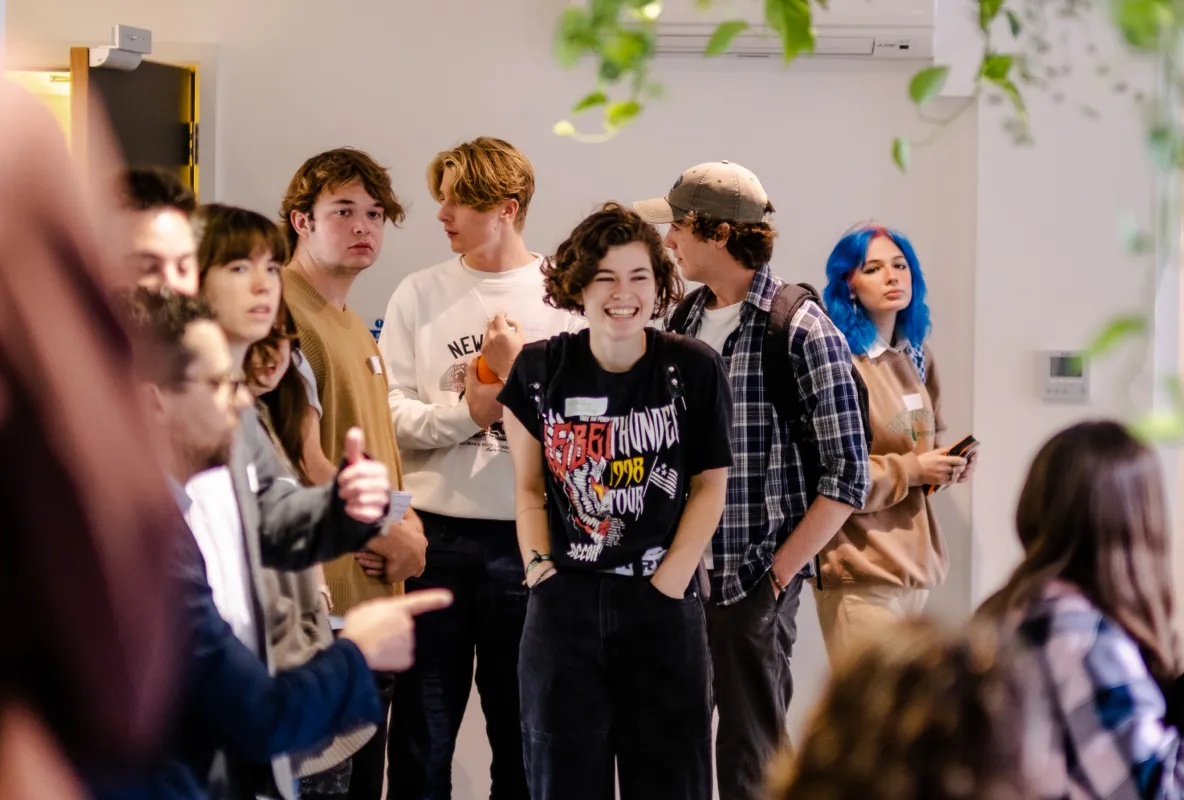
We host a range of events, both on campus and online, for you to learn more about LIS. We know that we’re new, we’re different, and that you might have questions. Events are one of the best ways to get them answered.
Explore our events




.svg)
