

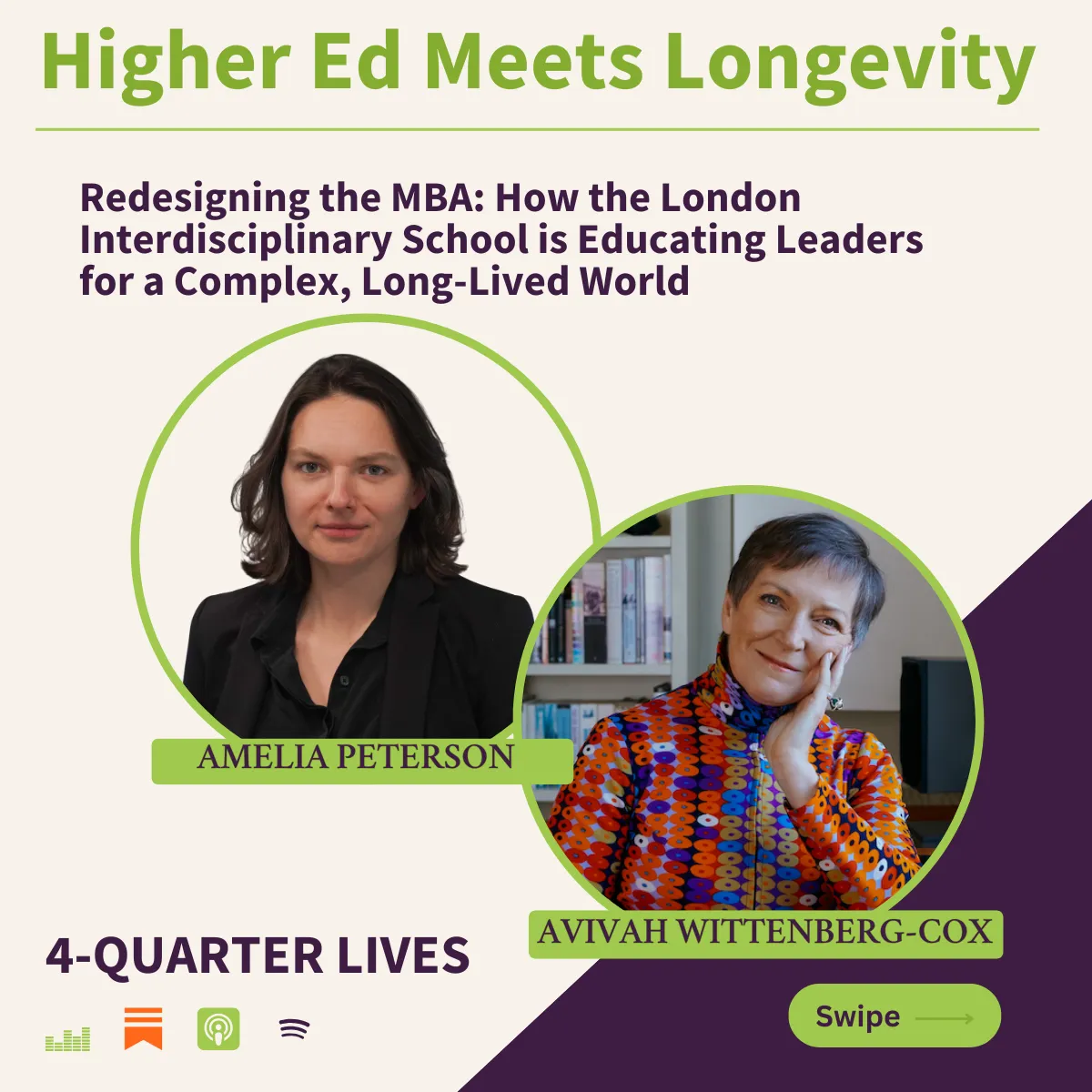
Redesigning the MBA: How the London Interdisciplinary School is Educating Leaders for a Complex, Long-Lived World
In this week’s 4-Quarter Lives, Avivah Wittenberg-Cox is joined by Dr Amelia Peterson — founding faculty member of the London Interdisciplinary School (LIS) — to explore how higher education can reinvent itself for an age of complexity, longevity, and accelerating change.
Amelia shares the story behind LIS’s bold rethink of the traditional MBA — an interdisciplinary programme designed not around internal business functions, but around six defining global “shifts”: complexity, intelligence, energy, ecosystems, trust, and longevity. These six forces, she explains, are reshaping work, leadership, and the skills needed to navigate an era of systemic uncertainty.
Unlike conventional MBAs focused on finance and management silos, LIS’s approach begins with the world outside organisations — the social, environmental, and technological transformations that leaders must now understand to act responsibly and effectively. Each “shift” is both a slide (a slow-moving global trend) and a shock (an accelerating disruption), demanding that leaders develop adaptive, long-term perspectives.
Amelia discusses how longevity became a cornerstone of the curriculum — linking demographic change and longer working lives to corporate time horizons and intergenerational collaboration. Drawing on her background in education policy and systems innovation, she outlines how LIS is creating programmes that combine academic depth with real-world application.
The new MBA-alternative is designed for mid-career professionals — typically in their late 30s to 50s — who want to keep working while studying. The 18-month, part-time format blends immersive residential weeks with hybrid learning, offering time for what LIS calls the “inner shift”: personal and interpersonal development alongside intellectual exploration. Amelia also highlights how LIS is tackling accessibility in higher education — offering a world-class programme at roughly half the price of elite US equivalents..
As higher education faces its own “midlife crisis” — demographic shifts, AI disruption, and declining enrolments — LIS is testing how universities can stay relevant. Amelia sees its role as “innovating on behalf of the system,” developing new models of learning, assessment, and leadership that larger institutions may one day adopt.
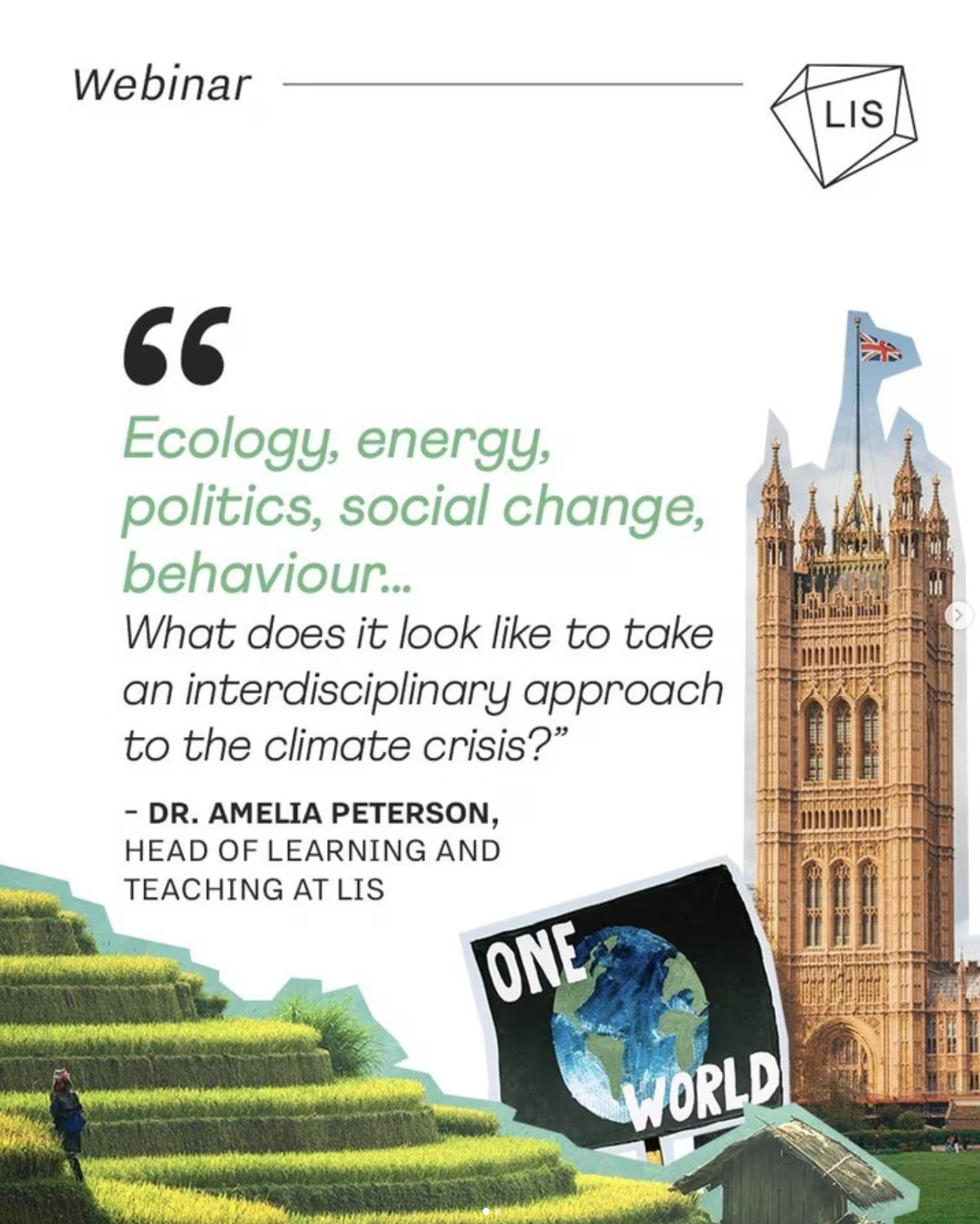
Dr Amelia Peterson is a social scientist and founding faculty member at the London Interdisciplinary School (LIS), where she leads curriculum innovation and programme design. Her research bridges education policy, systems change, and the future of work, focusing on how learning environments can prepare people to tackle complex, real-world problems. Before joining LIS, she worked with the Innovation Unit, advising governments and public-sector leaders on education reform, and held academic positions at the Harvard Graduate School of Education and the London School of Economics. She holds degrees from Harvard and LSE and is a leading voice on rethinking higher education for a changing world.
4-Quarter Lives







.svg)
