Future of Work
Immigration
Belonging
Social Isolation
Gender
Climate Policy
Social Media
Food
Supply Chains
Circular Economy
Community
Nature
Waste
Identity
Housing
Art
Climate
Fashion
Media
Wellbeing
Health
Sport
Culture
Technology
Care System
Government
Politics
Law
Urban Design
Inequality
AI
Education
Ella Cockman
BASc Year 3

Language Has Changed, Ideology Has Not

Social Media
Gender
Education
AI

Summary

Methods
Thematic Analysis
Discourse Analysis
Content Analysis
Case Study
Natural Language Processing
Data Science
Statistical Analysis
Permutation
Disciplinary perspectives
Computer Science
Linguistics
Sociology
Education
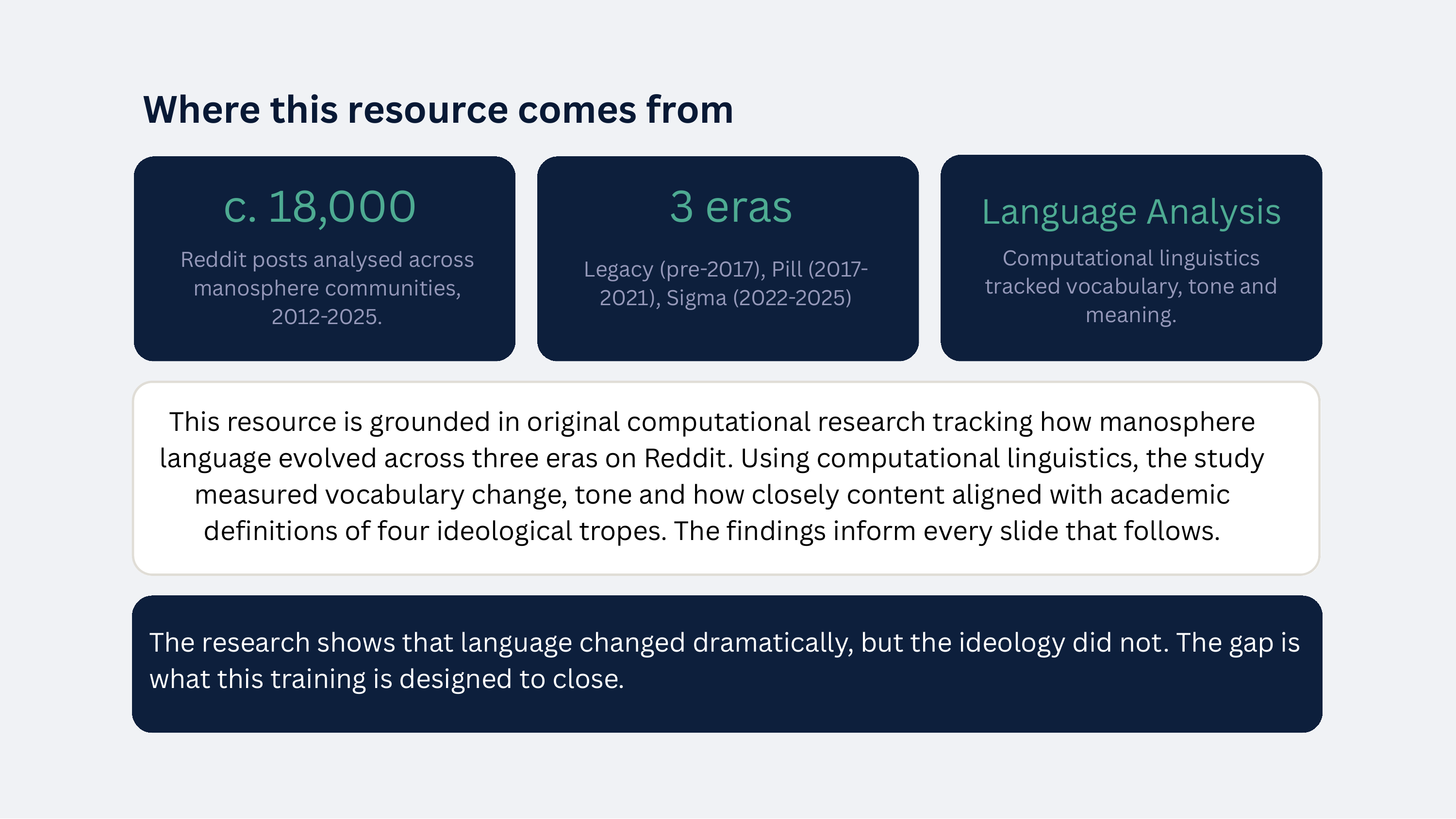
This project asks a simple question: has manosphere ideology actually changed over time, or just the words used to express it? I studied 17,950 Reddit post titles from four communities, spanning 2012 to 2025, split into three periods (Legacy, Pill, and Sigma). Using a mix of computational text analysis and close reading, I tracked how the vocabulary changed and whether the underlying beliefs changed alongside it. I found that while the words shifted a lot (63% of the vocabulary turned over), the beliefs actually became slightly more entrenched, not less, and the emotional tone barely changed at all. I then tested whether an AI detection tool trained on older posts could still recognise this content once the language had moved on. It couldn't, its accuracy dropped sharply. I used this to build a real world training resource for schools on recognising this language once it stops sounding hostile and starts sounding like self improvement advice.

Approach and Methodology

Manosphere content is often treated as a single, worsening problem. But understanding whether it is actually intensifying, or simply adapting its language to sound more acceptable and avoid moderation, matters directly for how schools and platforms are meant to recognise and respond to it.

I used a mixed methods approach, analysing the same set of Reddit posts both statistically and by close reading. Statistically, I measured how much the vocabulary changed between time periods, which specific words became more or less common, whether the emotional tone of posts shifted, and how closely the language matched academic definitions of manosphere beliefs. I also tested how well an AI model trained on older posts could still recognise newer ones. Alongside this, I closely read a smaller set of posts by hand to understand how belief can be expressed without using any obviously hostile words, which the statistics alone couldn't show.

17,950 Reddit post titles from four communities, and two unrelated communities used as a comparison, covering 2012 to 2025. I found that 63% of the vocabulary changed between the earliest and most recent period, while the underlying beliefs, measured against academic definitions, actually became slightly stronger, not weaker.

Bringing the statistical and close reading findings together showed these weren't two separate stories, but one: the words were changing while the beliefs stayed the same or hardened. This let me identify two distinct reasons AI detection tools fail, one that better training data could fix, and one that couldn't.

Proposal/Outcome

I found that a detection tool trained on older posts became much worse at recognising newer content (accuracy dropped from about 98% to about 73%) mainly because it had learned to treat friendly, advice style language as harmless, exactly the style modern manosphere content increasingly uses. This led me to describe two separate reasons AI struggles to catch this material: one caused by using outdated training data, which retraining can fix, and one caused by beliefs being implied rather than stated outright, which retraining alone cannot fix. This distinction fed directly into a real world resource: a training session called "Curiosity, Not Diagnosis," built with input from Matt Pinkett (Woke2Bloke), for teachers, pastoral leads, and designated safeguarding leads. It forms the middle day of a three day school programme (observing the school first, then training staff, then working directly with students) and teaches staff to recognise the same underlying beliefs once they've stopped sounding like harassment and started sounding like ambition or self discipline.

Beyond Outcomes

Beyond the findings themselves, I'm proudest of where this project has led. It's directly shaped the real world work I'm doing now, including my researcher role with Everyone's Invited and joining FlippGen's youth digital safety community. It's also confirmed that this is the space I want to keep working in: I'm starting a Masters in the Social Science of the Internet at Oxford this October, building on exactly these questions about how ideology moves through online language.

Want to learn more about this project?

Here is some student work from their formal assignments. Please note it may contain errors or unfinished elements. It is shared to offer insights into our programme and build a knowledge exchange community.

Author's Final Reflection

Overall LIS Journey

Academic References

About me

Hi, I’m Ella. I’m about to start my third year at LIS and have really enjoyed the interdisciplinary journey so far. I love combining my interests in sociology, psychology, and computational linguistics to better understand culture, media, and technology. Outside of academics, I enjoy swimming, sauna sessions, keeping fit, and socialising with friends—activities that help me find balance and stay grounded. This summer, I’m interning at Stamp, where I’m conducting research on ethics and certification frameworks for technology companies, deepening my understanding of responsible digital innovation.

Other Related Projects

Back to the repository

Language Has Changed, Ideology Has Not

It's often assumed that "manosphere" online communities are becoming more extreme in a simple, escalating way. But almost no research has actually tested whether the underlying beliefs have changed, or whether the same beliefs have just been repackaged in newer, softer sounding language, as the culture has shifted from explicit "pickup artist" talk to "sigma male" self improvement content.

Social Media
Gender
Education
AI
How Can A Computational Model Guide the Optimisation of Interdisciplinary Team Design

 - A Pilot Based on Heathrow's Sustainability Goals

AI
Future of Work
Technology
Polluted Information Ecosystems in the Pursuit of Unpolluted Air

How and why did misinformation about the ULEZ policy spread online?

Media
Technology
Climate Policy
Climate
Social Media